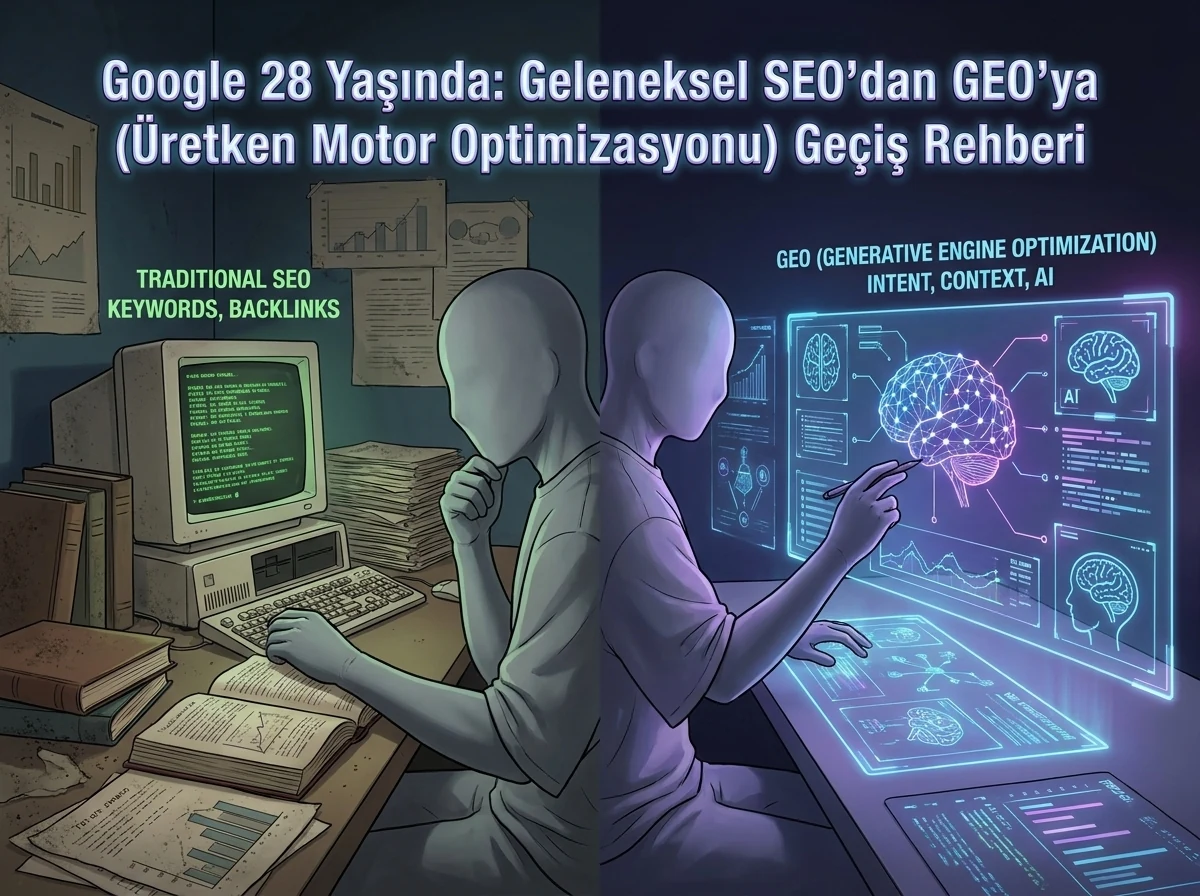
Google Turns 28: The Definitive Guide from Traditional SEO to GEO (Generative Engine Optimization)
- 1. Foundational Shift: Moving from Click Economy to Citation Economy
- 2. Metric Transformation: 'Where Do I Rank?' vs. 'How Does AI Describe Me?'
- 3. Empirical Insights from the Princeton GEO-Bench Study
- 4. Technical Imperatives: Why Next.js (SSR) Outperforms Legacy WordPress
- 5. Structuring Content with Dedicated 'Answer Blocks'
- 6. Winning in the Zero-Click Reality
"According to Gartner, overall search volume is projected to decline by 25% by 2026 as Zero-Click queries reach 83%. Yet, AI-referred visitors convert at an astonishing 14.2%—more than five times higher than traditional organic search traffic (2.8%)."
From Search Engines to Action & Answer Engines: The 28-Year Paradigm Shift
1. Foundational Shift: Moving from Click Economy to Citation Economy
Answer Block: While traditional SEO aims to win URL clicks from search engine result pages (SERPs), Generative Engine Optimization (GEO) focuses on getting your brand cited and recommended as a verifiable knowledge piece (fact) within AI-synthesized responses. In the link economy, success was measured in pageviews and click-through rates. In the emerging citation economy, large language models deliver direct answers within conversational interfaces, shifting the unit of value from entire URLs to verifiable factual entities.
| Dimension | Traditional SEO | Generative Engine Optimization (GEO) |
|---|---|---|
| Primary Objective | Rank URL in top positions on Google SERPs | Get cited and recommended within AI answers |
| Core Unit of Value | Clickable Web Page URL | Verifiable Fact & Semantic Entity |
| User Interaction | Clicks link and browses website | Reads direct synthesis within AI chat (Zero-Click) |
| Query Format | Short, keyword-centric (e.g. 'web design agency') | Conversational, long-form question (e.g. 'Which agency builds Next.js sites with top GEO scores?') |
| Execution Mechanism | Crawl → Index → Rank | Semantic Chunking → Retrieval → Synthesis → Citation |
| Key Success Metrics | Rank Position, Organic Traffic, CTR | Citation Frequency, Share of Model (SoM), Sentiment Score |
2. Metric Transformation: 'Where Do I Rank?' vs. 'How Does AI Describe Me?'
Answer Block: Organic search position alone is losing relevance; modern performance is driven by Share of Model (the percentage of category queries in which an LLM cites you) and Sentiment Score (the qualitative tone of algorithmic endorsement). While traditional SEO may capture 100,000 visitors at an average 2.8% conversion rate, AI-referred visitors arrive pre-vetted with crystal-clear buying intent. Research reveals a 14.2% conversion rate for AI-referred traffic—delivering far greater revenue from fewer, higher-quality sessions.
| Metric Area | Traditional SEO Focus | GEO Metric Benchmark | Commercial Impact |
|---|---|---|---|
| Visibility | SERP ranking position (1-10) | Citation Frequency | Frequency with which AI names your company as an authority. |
| Traffic Volume | Monthly organic sessions | Zero-Click Reach & Qualified Inbound | Brand awareness established even without an initial site visit. |
| User Intent | Click-Through Rate (CTR) | Share of Model (SoM) | Percentage of industry prompt responses recommending your brand. |
| Algorithmic Authority | Domain Authority & Backlinks | Entity Association & Vector Proximity | Semantic closeness of your entity to core industry competencies. |
| Conversion Quality | Average lead conversion (~2.8%) | AI-Referred Lead Conversion (~14.2%) | Five times higher revenue efficiency per engaged visitor. |
Need a customized digital growth roadmap for your business?
Chat with Nexentio experts on WhatsApp directly to get a tailored strategy for your brand.
3. Empirical Insights from the Princeton GEO-Bench Study
Answer Block: According to the official GEO-Bench research conducted by Princeton University, Georgia Tech, and the Allen Institute for AI across 10,000 queries, adding verifiable statistics and expert quotes elevates AI visibility by up to 40%, whereas legacy keyword stuffing inflicts a 10% penalty. Large language models are fundamentally engineered to minimize hallucination risk. Consequently, subjective marketing claims ('We are the top agency') are suppressed, whereas verifiable data points ('Next.js SSR architecture speeds up load times by 68% in Nexentio audits') are prioritized as authoritative knowledge anchors.
| Optimization Strategy | Impact on SEO | Impact on GEO (AI Visibility) | Algorithmic Rationale |
|---|---|---|---|
| Including Verifiable Statistics | Mild positive (+10%) | Critical Gain (+35% to +40%) | LLMs treat numerical data as grounded factual anchors. |
| Citing Credible Sources | Neutral / Mild positive | Critical Gain (+30% to +40%) | AI models prefer external attribution to reduce liability. |
| Expert Quotes & Attributions | Supports E-E-A-T | Critical Gain (+30% to +40%) | High-entropy expert quotes elevate model confidence scores. |
| Authoritative Technical Tone | Limited impact | Moderate Gain (+15% to +20%) | Precise technical vocabulary is preferred over vague adjectives. |
| Keyword Stuffing | High risk / Penalized | Actively Harmful (-10%) | Repetitive low-entropy text triggers AI spam mitigation filters. |
4. Technical Imperatives: Why Next.js (SSR) Outperforms Legacy WordPress
Answer Block: Autonomous AI web crawlers (such as GPTBot and PerplexityBot) cannot reliably execute complex client-side JavaScript; hence, Server-Side Rendering (SSR) or Static Site Generation (SSG) via Next.js is essential for flawless machine readability. Legacy WordPress sites burdened with cumbersome plugins and render-blocking scripts exhaust LLM crawl budgets. In contrast, modern Next.js architectures render pre-compiled, pristine HTML on the server, ensuring AI bots ingest structured data and semantic chunks without latency.
- Clean Server-Side HTML Output: Ensures GPTBot and Googlebot ingest semantic content instantly with zero client-side hydration delays.
- Native llms.txt Integration: Provides AI crawlers with clean markdown sitemaps and API documentation directly at the root domain.
- Hierarchical Heading Architecture (H1-H3): Eliminates unstructured div markup in favor of logical outline trees.
- Comprehensive Schema.org Graph: Connects Organization, Person, FAQPage, and Service entities into an interconnected knowledge graph.
5. Structuring Content with Dedicated 'Answer Blocks'
Answer Block: AI engines extract standalone text chunks rather than parsing entire long-form articles; therefore, every H2 or H3 heading must be immediately followed by a concise 1-3 sentence direct answer. Burying the definitive answer at the conclusion of a 3,000-word article is obsolete. Modern content engineering demands an Inverted Pyramid hierarchy: 1. Question-Formatted Headings: 'What Are Enterprise SEO Costs in 2026?' instead of 'SEO Pricing Overview'. 2. Immediate Direct Answer: State the factual range or conclusion in the first two sentences. 3. Follow-Up Data & Empirical Proof: Expand with structured comparison tables and step-by-step implementation protocols.
Nexentio Architecture Note: Every section in this guide demonstrates our production-tested Answer Block standard, engineered specifically for retrieval-augmented generation (RAG) by search bots.
6. Winning in the Zero-Click Reality
Answer Block: With Zero-Click interactions climbing to 83%, websites must transition away from basic dictionary definitions toward proprietary case studies and actionable frameworks that AI models cannot synthesize on their own. Generic informational queries ('What is SEO?') will no longer drive commercial traffic. Sustainable digital growth requires: • Proprietary Case Studies: Granular accounts of how specific customer challenges were solved. • Original Data & Benchmarks: First-party performance metrics from your company's own client operations. • Transparent Market Pricing: Live pricing matrices that search engines rely on as trusted sources.
- Abandon Generic Definitions: Focus exclusively on solving high-stakes business challenges.
- Publish First-Party Research: Share your team's real-world data and benchmark outcomes.
- Reinforce E-E-A-T Credentials: Feature verifiable author bylines and company leadership credentials on every published insight.
Frequently Asked Questions
Should we abandon traditional SEO in favor of GEO?
What is the single most effective tactic for AI citation?
Is legacy WordPress sufficient for enterprise GEO?
What purpose does the llms.txt standard serve?
How does my business grow if Zero-Click searches reduce website visits?
Conclusion: Who Will Win the Next Era of Digital Visibility?
Let's explore your business's digital potential together. Get in touch now and let's create the difference together.
Let's explore your business's digital potential together. Get in touch now and let's create the difference together.